
The Pittsburgh Potty

Let's address the elephant in the room.
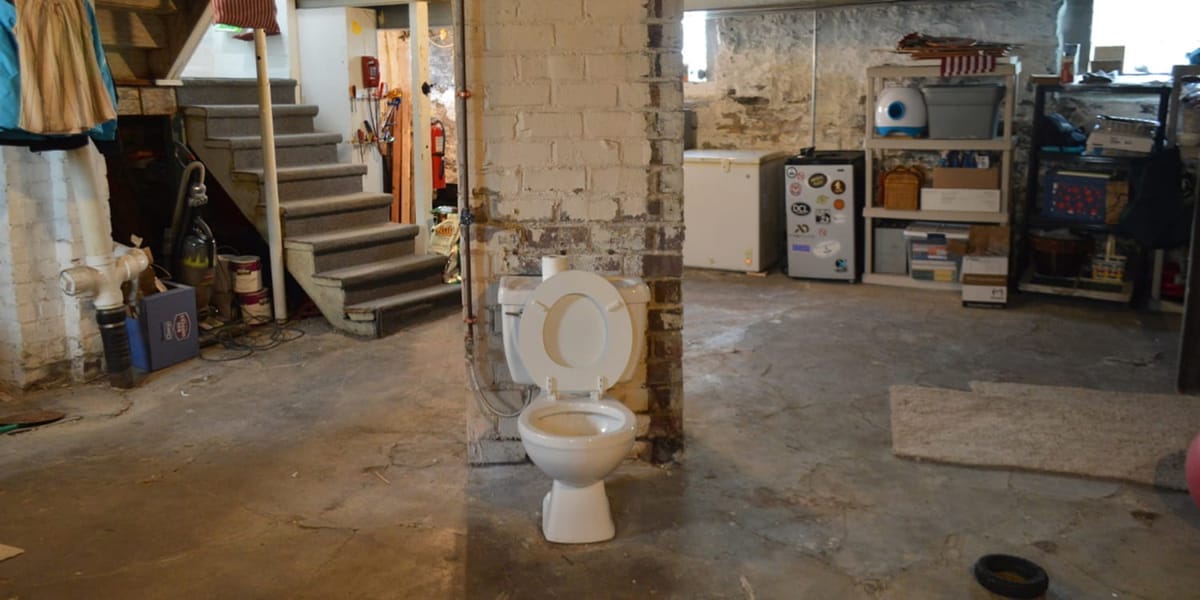
The room: a Pittsburgh basement.
The elephant: a porcelain toilet in the middle of the floor. No walls surround it, not even a curtain.
It looks old, yet unused, like the Ti-D Bowl Man did his job and moved on to bigger and better toilets years ago.
Amy points at it, "Uh, what is that?"
I add, "And what's in doing in the middle of the basement?"
Sharon the Real Estate agent declares "Oh that. That's a Pittsburgh Potty"
You can tell she has answered this question a million times before. But Sharon is a really good agent, and doesn't immediately cut off this line of questioning. She just kind of lets the statement hang in the air for shock value.
The smart thing would have been to let it go. Move on to the kitchen or whatever.
Obviously we were not smart.
"What's a Pittsburgh Potty?" I ask.
All You Can Leave Behind
Living in Pittsburgh means answering a particular set of questions over and over again:
- How do I get from point A to point B when there's this giant gully between them?
- Should I root for my home team even though they kinda suck?
- What history should I haul off to the dump? What history should I leave?
Let's take that last question. Look at this thing:
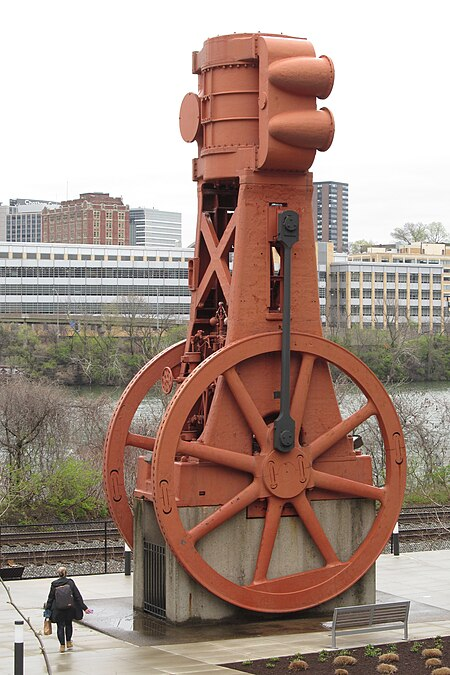
This is a giant blowing engine that sits on the South Shore of the Monongahela River in Pittsburgh. It is 4 stories tall - see that puny human next to it? This engine did real work in a steel mill, blowing air into the blast furnace that kept the extremely hot fires working. Now it's useless, but it looks pretty cool, and a coat of paint on it turns it into a unique work of art. Pittsburgh is proud of their steel heritage, and they use relics to symbolize their gratitude.
The Pittsburgh Potty is not art. Well, maybe the Andy Warhol school of art, but ...
Sharon explains the Pittsburgh Potty. "You get them in homes built in the early 1900's. When the men came home from the steel mill, they were all grimy and nasty, and their wives didn't want them tracking through the house. So they came in through the basement door, washed up, took a little shower or whatever, did their business on the Pittsburgh Potty and came up the stairs for supper. They did that every day of the week."
It's a beautiful story. Those men working such a tough life in the oppressively hot steel mills, dragging their tired body home ... and yet, they had enough respect for their families to clean themselves up and not mess up the other bathrooms in the house. How thoughtful they were.
Yep, it's a beautiful story.
But I dunno. It's just a little too pristine, and I later find it's a little too much like everyone else's explanation. Like the Yinzers corroborated their stories before the Pittsburgh Invaders piled onto their shore.
The Truth Goes a Little Deeper
Being the resident skeptic, I can't let this one go, and I start pulling at those threads on the proverbial sweater:
- OK if there's still a Pittsburgh Potty there, why isn't there a shower? Would they really have pulled the shower (which is a useful thing) and left the Pittsburgh Potty behind?
- And where is the sink? Sure some basements have a utility sink, but they are on the other side of the basement altogether.
- Why is the Pittsburgh Potty in the middle of the floor? Where are you gonna hang the toilet paper?
- And why is it so clean?
Trust me, I have seen old toilets. My alma mater (the University of Nebraska) boasted of having the oldest porcelain fixtures west of the Mississsippi - the celebrated Hinsdale Urinals of Architecture Hall.
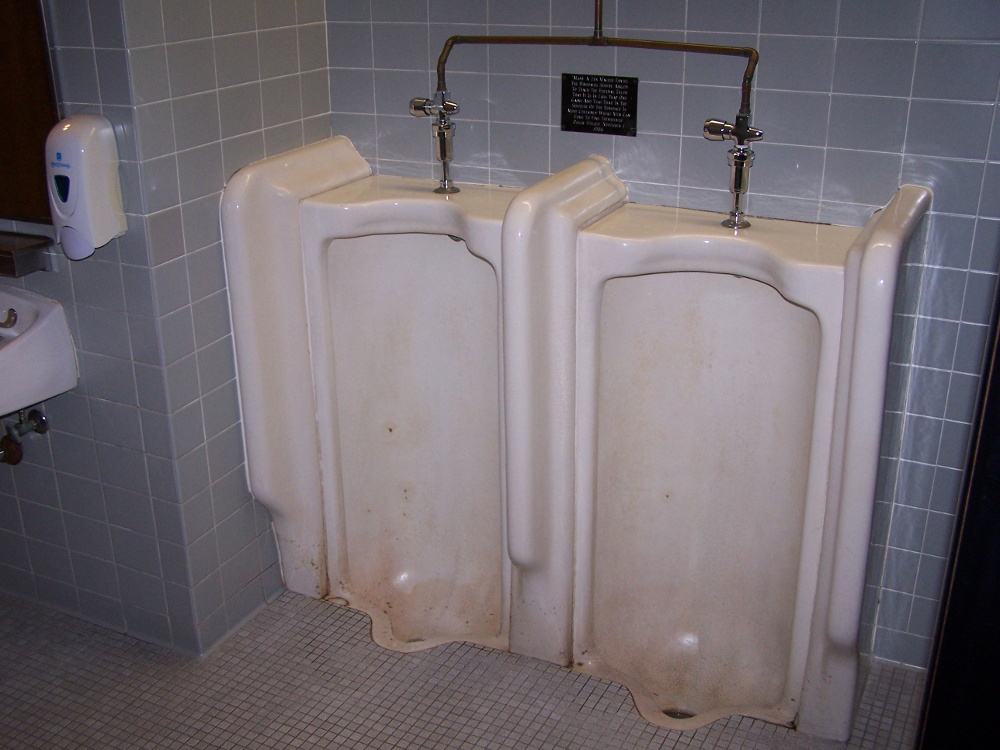
Isn't that darling? And they have a little plaque above them! I'm so glad the University of Nebraska spent my tuition money on that plaque instead of ... you know, education. Not like I'm bitter or anything.
Anyway, aspects of the Pittsburgh Potty story do not add up.
So I do a little investigation on the Internet. The Internet, it turns out, is pretty useful for investigating all kinds of stuff-that-doesn't-matter. Who knew?
Anyway, put yourself in a 1900's steelworking family's shoes a moment. You are building a house, or maybe you already have one, and municipal sewer lines are a new thing in your town. They are not especially trustworthy. You can't guarantee all the stuff your neighbors cram into it is going to go down the pipe.
Uggh, now we are getting it. Hope you haven't had your dinner yet!
Anyway, you have a little spending money to put in one toilet. Where are you gonna put it? As close to the sewer line as possible. Makes sense. And no one prowls around in the basement, so you have some privacy without building an expensive wall. Oh sure, down the road you might want to add things like bathtubs and sinks. But for now a toilet as a stop-gap measure.
Stop-gap. I know, I know ... I need to quit this, but I can't help it.
Installing the toilet in the basement also gets you this side benefit. When the sewer lines back up ... which they will inevitably do because this is 1900 and the American diet is 50% pork fat ... they will back up into your toilet in the basement and not in the rest of your house. Water (and other stuff) seeks its lowest level. At least in the basement, you have a good shot at cleaning it up. Plus it's easier to clean up in a toilet than all over the basement floor.
The First Toilet
Meh. That all seems a little more plausible. But the fact is we really don't know how the Pittsburgh Potty became "a thing." The records on it are scant. It's not a real selling point for a house. "A three-bedroom townhouse in the Lawrenceville neighborhood with Central Air, an eat-in kitchen, and a balcony that looks over Troy Hill. And WOW - a Pittsburgh Potty!"
We only know that the lone basement toilet is not just a Pittsburgh thing. Basement toilets can be found all over New England, and even as far away as Wisconsin. It is probably better called a First Toilet, because it was the first one installed in the house.
But Pittsburgh often raises its hand and declares itself the Prime Mover (sorry, sorry, so sorry) in so many arenas. Someone called it a Pittsburgh Potty and Yinzers proudly repeated it over and over. It's sort of ironically funny in that Pittsburgh sense. And you gotta admit. The Steelworker-Who-Wishes-Not-To-Offend is a good story. It tells you a lot about the Pittsburgh character.
Amy and I ended up buying a townhouse built in 2009. It has a bathroom on the first floor which is not a Pittsburgh Potty - it is a proper half-bathroom with a toilet, a sink and (most importantly) a door. It has an extremely high ceiling because of the weird slope the townhouse straddles.
It is also the warmest room in the house. It sits right next to the furnace, which is tucked into its own little cubbyhole along with the water heater. When I come in from a frigid, 50 mile bike ride, that's the room I make a beeline for. In some ways, I am no different than a 1900's Steelworker, I suppose.
I wonder though. Some prospective buyers are gonna walk through our house 100 years from now. What will they point at and ask:
"What is that? And what is it doing in the middle of the basement floor?"